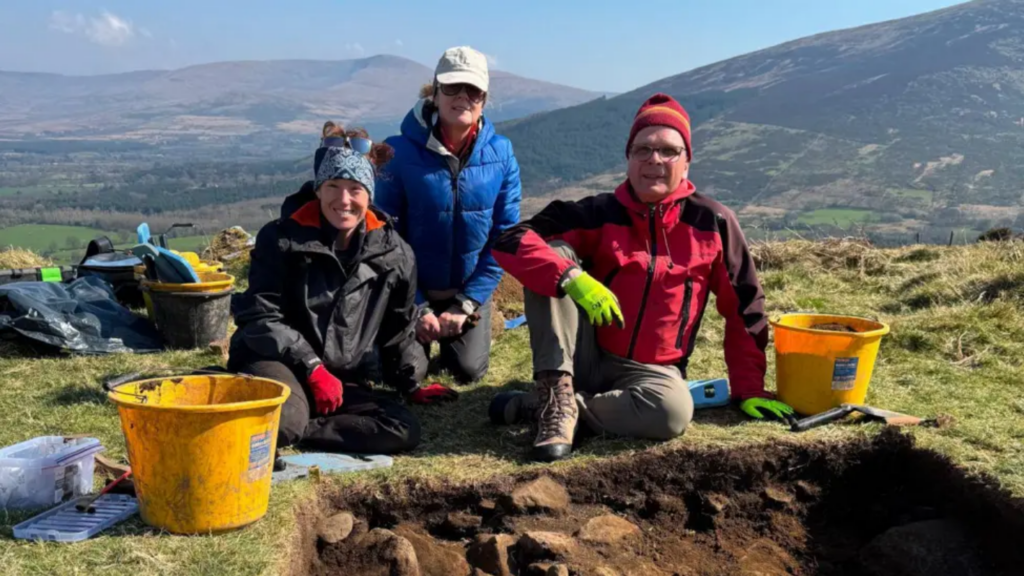
The student Cherie Edwards, along with Dr Dirk Brandherm and their archaeologists team have discovered an exceptionally large prehistoric hilltop settlement in Ireland that may challenge the long-held belief that the Vikings founded the island’s first towns. Researchers led by Dr Dirk Brandherm have identified more than 600 suspected roundhouses at the Brusselstown Ring, making it the largest nucleated settlement ever found in prehistoric Ireland and Britain. The site, located within the Baltinglass Hillfort Cluster on the south-western edge of the Wicklow Mountains, is believed to date to around 1200 BC in the Late Bronze Age.
The findings, recently published in the peer-reviewed journal Antiquity, highlight the site’s remarkable size, density, and architectural complexity. Although the area has been surveyed for over 20 years, test excavations began in 2024 to address unresolved questions about its development and function. Evidence suggests the settlement was mainly occupied during the Late Bronze Age, with some reuse in the Early Iron Age.
The discovery is significant because it contradicts the traditional view that Bronze Age communities consisted only of small hamlets. By comparison, the Corrstown site in Northern Ireland, with 74 houses, was previously considered the earliest village of the period. Brusselstown Ring, however, may represent a proto-town dating 2,000 years before the Vikings.
The settlement is enclosed by two ramparts spanning two hills, with most houses located between them. A stone-lined structure thought to be a water cistern was also found, potentially the first of its kind in Ireland.
The BBC news website has given voice to the findings, and you can read it for further details through this link: BBC News – New discovery may challenge theory Vikings built first Irish towns
Notes for Editors
| Published | Thursday January 15th, 2026 |